It’s the crack of dawn and the autumn sun is rising over Tilghman Island. Fishing was tough during the transition from summer to fall, but this late September morning, I’m hopeful. All the sudden a full-on bird show ensues right in front of the boat. Peanut bunker fly out of the water as I cast my paddletail into the foaming fury. My lure gets whacked, and a second later is gone forever. Aha! Bluefish. This is going to be fun. I scramble over to my tackle box and unlatch it, working frantically to untangle my mess of jigs, plugs, and metals. Finally, I manage to work free a Stingsilver and tie it on. But… the bird show is already over.
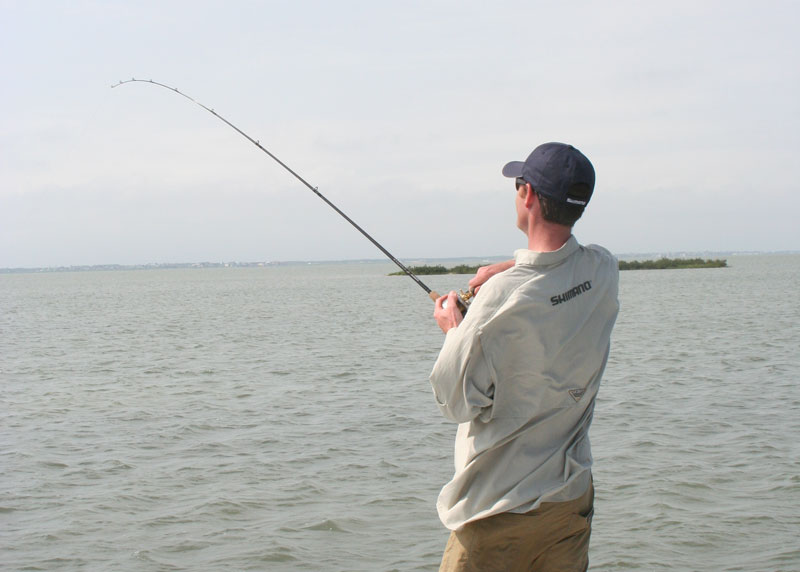
And that was all the action I saw that morning. I failed to capitalize on that school of bluefish, and it wasn’t a skill issue, a boat problem, or uncooperative fish. It was a lack of organization and preparedness that was my downfall this day.
Tackle organization is an often overlooked yet essential tool for maximizing efficiency and effectiveness while on the water. Those few minutes it took me to untangle my lures was the difference between bluefish in the cooler and a skunk. So, I now make it my mission every winter to completely and meticulously organize my tackle. There are a few methods that have worked well for me, and I’m happy to share them today for the sake of maximizing time spent with a lure in the water, saving hours of digging through boxes the night before a big trip, and knowing exactly what you’re tying on without a second thought.
Method #1: Organizing by Species
My system consists of several tackle trays, Ziplock bags, and an old bookbag. The fishing industry pushes hundreds of different products relating to tackle storage, and many of them are fantastic, however I find that my “budget” method works perfectly well and keeps me organized. Each trip, I bring a selection of tackle trays filled with assorted lures and zip lock bags filled with soft plastics, and I stuff them into my backpack along with other essential gear.
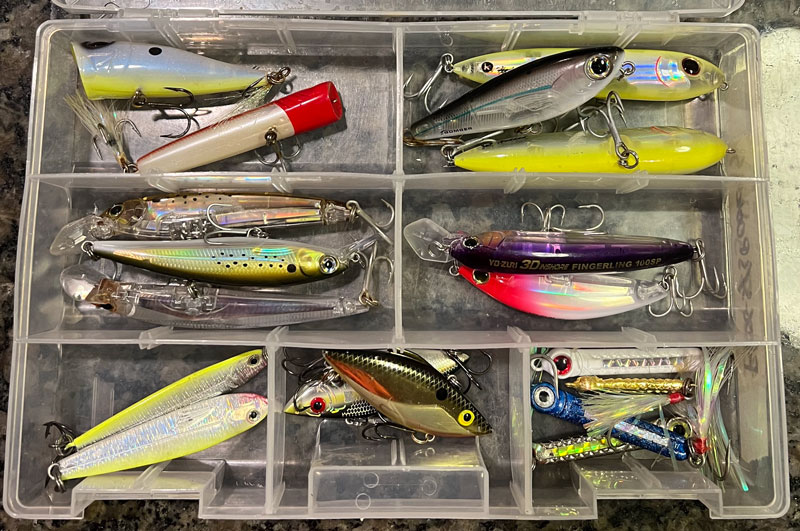
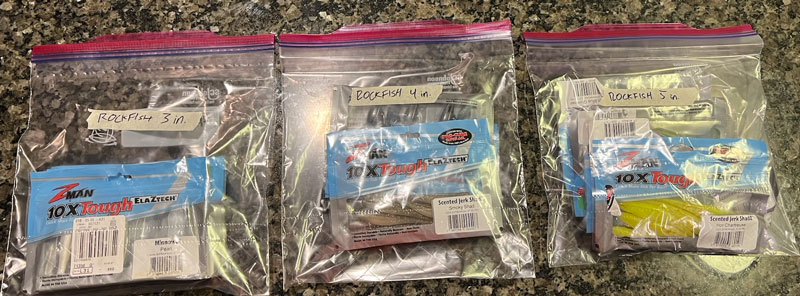
To discuss organizing by species, let’s use rockfish as an example. I have a tackle tray full of plugs and metal jigs, but it’s important to note that they are not just thrown in willy-nilly. Most tackle trays come with little plastic dividers. Use them. I’ll divide the box up into sections, and fill each section with no more than a few lures. This way, if hooks do get tangled, it’s easier to deal with just a couple lures as opposed to a ton. I usually slap a piece of masking tape on the box and write, “Rockfish Plugs.” A second tackle tray will contain soft plastic jigs, organized into sections by jig head weight, labeled “Rockfish Jigs.” Finally, I’ll fill three plastic bags with different sized soft baits. One is full of three-inch tails, another with four-inchers, and a third with five-inch baits. Obviously we upsize as the weather gets colder, but for the sake of this example we’ll leave it at that. Each bag gets a label: “Rockfish 3 Inch,” “Rockfish 4 Inch,” “Rockfish 5 inch.”
Now, on the eve of your striper outing, you can head to wherever you store your tackle and grab your rockfish gear without having to scramble and spend time putting a box together at the last minute. And when you’re on the water, you won’t have a tangled mess of hooks and you’ll know exactly what jig size you’re throwing at all times.
Method #2: Organizing by Tackle Type
Not every piece of tackle can be sorted into a species-specific box, especially if you’re like me and have way more gear than you need. This is where organizing by tackle type can be extremely beneficial.
Let’s use terminal tackle for this example. I’ll typically have a box for all my hooks, with as many sections as I can possibly make using the dividers. Each hook is put into a section according to the type and size. So, I’ll have a row in my tackle tray of circle hooks arranged in sections from left to right, smallest to largest. In the next row I’ll have J hooks, and EWG hooks in the next. This way, I can use this box as general storage when building species specific boxes that may include hooks, or I can take this whole box with me on a bottom fishing outing. The same method of organization is applied to sinkers, with a row of pyramids arranged by weight, another row of egg sinkers arranged by weight, etc.
Organizing by tackle type can be very effective for anglers with excess gear in need of coordinated storage, and just as much for bait fishermen who want easy access to the exact weight and hook they require for a specific application while on the water.
Method #3: Organizing by Body of Water
If you’re a multispecies angler who doesn’t necessarily head out on the water with a target fish in mind, this system should speak to you. Say you’ve just gotten off work and have a brief window of daylight left, so you decide to head to your neighborhood lake or pond. Wouldn’t it be nice to skip the digging through your tackle for a random selection of lures, and instead have a box already nicely put together in your car?
The biggest thing to keep in mind when putting together a tackle tray that covers an entire body of water is to minimize tackle fatigue. What I mean by that is, only fill the box with what you know can catch fish—your confidence baits—and eliminate the excess time you spend thinking about what lure, in what color, and what size that you should tie on. No, you don’t need every color X-Rap in every size. Just pick one or two.
My ideal freshwater box is organized into divided sections with just a few different lure types and some terminal tackle to cover most conditions. I’ll fill compartments with one or two of each of the following lures: jerkbaits, squarebill crankbaits, lipless crankbaits, topwater frogs, and inline spinners. Then, I’ll fill a section with some pre-rigged plastics like Senkos, Ned rigs, and paddletails. Finally, the rest of the sections get filled out with extra EWG hooks and jig heads. For my plastic bag of soft baits, I’ll throw in extra Senkos, creature baits, and paddletails. Of course, both the bag and the tackle tray get labeled, “Freshwater.”
This method can be applied to any body of water, whether it’s a pond or lake, the Bay or the surf. It’s a great way to condense your gear but remain organized and ready to tie on any lure for any condition in the place you may be fishing.
Marrying the Methods
Now, what if I want terminal tackle in my rockfish box for live-lining? And what about a largemouth tackle tray that doesn’t cover all freshwater species for my quick, after work outings? That’s where you and your creative mind come in. Every individual has a unique school of thought, a particular method to their own madness. These systems of organization are not meant to be a set of rules, but rather a foundation of inspiration for your own tackle management scheme. So, bite the bullet next time you have a free day and get your gear organized. You’ll look back and thank yourself for it during the upcoming season, I promise.
-By Adam Greenberg