During spring and throughout summer red drum, speckled trout, and striped bass cruise the shallows here in the Chesapeake and its tributaries. Whether I launch my kayak on the St Mary’s River, the Potomac, the Piankatank, or on a shallow flat of the Bay, I might see schools of fish feeding. Tell-tale signs are what I look for while scanning the water include: tailing fish, surface feeding, shadows moving rapidly, shore birds feeding or birds hovering, or ever so slight movements on the water’s surface. All of these tell me that fish and/or bait is in the area. And I’m a firm believer that once these clues are spotted, kayaks have the upper hand in shallow water fishing. They only draft inches of water and are perfectly suited for it.
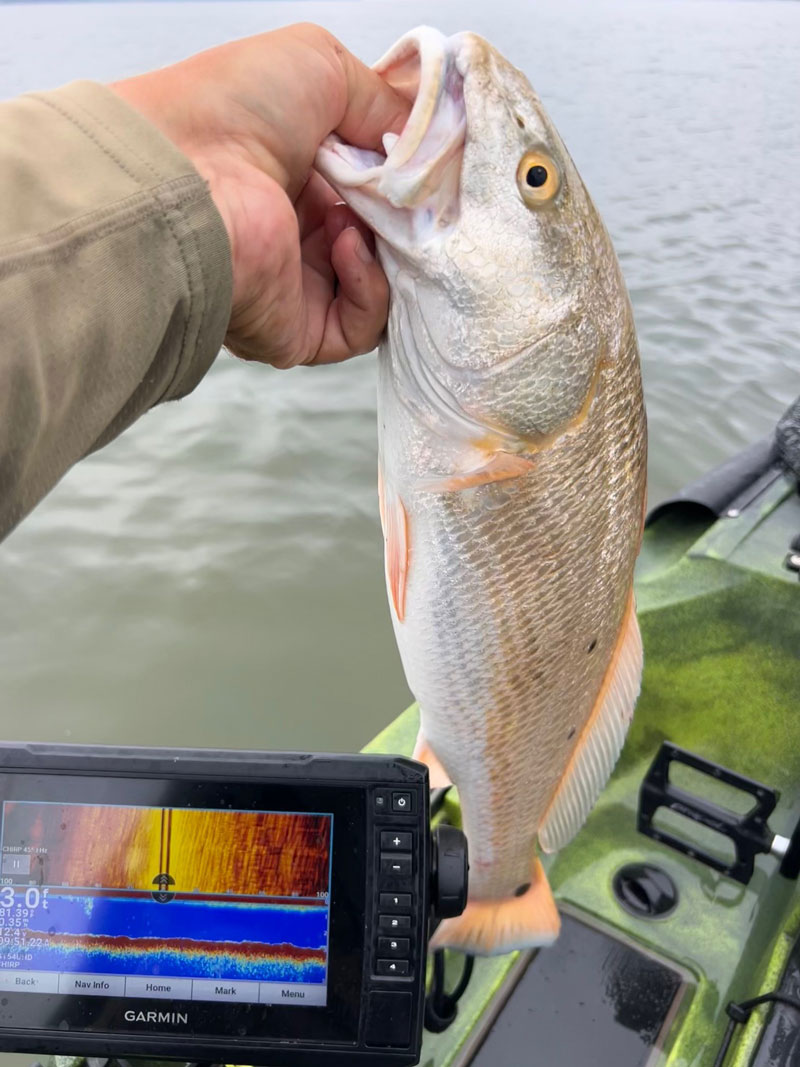
There will be instances when you’ll notice a school of red drum, approach them silently, and can get surprisingly close. Then, which rod do you grab to cast? The one rigged with topwater, a jig, or a popping cork? The fish may be fast on the move and you may need to chase them down, casting in front of them. They may be meandering along slowly. They may be related to structure and staying more or less in the same spot. Or, you may work a school that’s in a feeding frenzy. Realizing things change very quickly you have to be ready to make on-the-spot changes in your tactics.
In these changing situations on the flats I may carry up to six rods, each rigged with a different bait. One with a popping cork, set up with a small jig 16” to 18” from the cork. Another, a topwater bait. Others may have light jigs, each rigged with a different color plastic of different lengths and profiles. Anther rod I’ll rig with a hard bait.
In the early part of the day it’s often effective to start by casting topwater baits, skipping them across the surface. As the morning moves on, switch to jigging, throwing the jigs and hopping them over grass or near structure. Where you notice areas that have no grass or structure stop swimming the bait at the edge of the grass and jig it along the bottom. If you see a school of fish feeding you can throw the jig or try the popping a cork, casting beyond them and working the cork up towards the fish. At times, a topwater bait will work here, too.
If you don’t see bird activity or schooling fish, try trolling a hard bait and/or a swim bait over grass and/or along drop offs. Try this at just under two mph. This is another time when being on a kayak shines, because even with a trolling motor on a big boat trolling such slow speeds in shallow water can be difficult. And if you locate a concentration of fish, then you can fancast the area with a light jig. Casting into deeper water and working the bait up and along a drop off usually becomes more effective as the day advances. As the day grows longer, into the evening, you can return to the tactics used in the morning.
Start hunting for redfish, speckled trout, and stripers in the shallows once the grasses start to show up on the shallow flats. Some of these grasses will only stay around for a few months then die off, others remain all summer. Scattered rock, oyster beds, and the edges of drop offs near grass will also hold fish.
Stealth is needed here. A slow, shallow drafting, quiet boat is best for stalking these fish. Stay low and stay quiet. Whether you’re hopping, skipping, or jigging that bait, think: kayak.
-By Eric Packard