You're trying to catch some largemouth bass... or crappie... or whatever - and the lack of bites is driving you crazy. Maybe the fish are simply ambivalent about your bait. Or they’re holding tight to a drop-off and won’t move an inch, so you need to work a bait in the strike zone without moving it much. Or the fish may look at your lures but refuse to chase them as they zip past. In all of these scenarios a likely solution to your angling angst is an application of the drop-shot rig, which is known for working well on lock-jawed and highly pressured fish.
What is a Drop-Shot?
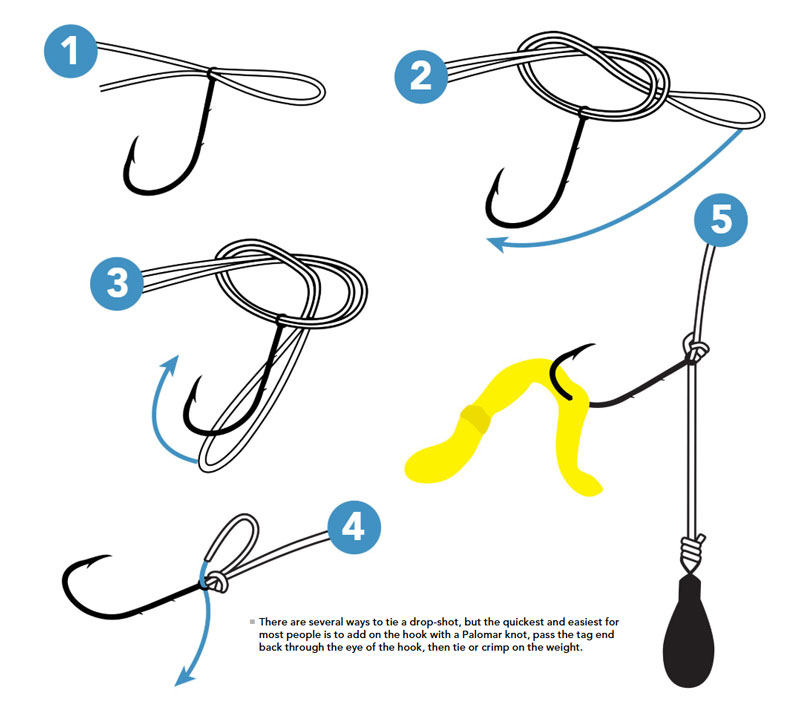
A drop-shot rig is, at its most basic, adding a weight to the very end of your line and tying in the hook above the weight, and then adding a lure or bait. The length between the weight and hook can vary by how you tie the rig and should be changed to meet the situational requirements. If the fish are two feet off bottom, for example, a three-foot distance between the weight and hook should prove effective. This will allow you to present that bait and gently jiggle or quiver it without moving it out of the strike zone or changing its depth.
Drop-shot rigs can be tied out of virtually any size line, but as a rule, it works best with monofilament as opposed to braid. Braid droppers tend to tangle and can become a huge mess in short order, but this is much less of a problem with slightly more rigid mono lines. If your mainline is braid it’s best to use a Palomar knot to tie a small, light swivel to the end of your line. Then tie the drop-shot rig out of mono or fluoro leader, tie a loop at the top, and clip it on.
As for your offering, it can take a number of forms but is most commonly a neutrally buoyant or slightly off-buoyant soft plastic, such as a fluke, worm, or tube. Size and color will of course vary by the target species and conditions. But you can also fish bait on a drop-shot and it’s often an effective way of presenting a live shiner or minnow.
How to Fish a Drop-Shot
A drop-shot rig can be fished in countless ways, but most of the time it boils down to fishing it vertically, cast and retrieved, or drifted. Use the vertical presentation when you’re directly above the fish and have spotted them on the meter. Simply drop down until the weight hits bottom, and use slight jiggles of the rod tip to give your offering some wiggle.
Casting and retrieving allows you to present the bait to various forms of structure by casting at or just beyond it, retrieving until it’s in position, then jiggling. With the line taunt drop your rod tip toward the rig enough to let a slight bow into the line, then jig it back just enough to come taut again without actually moving the weight. Doing so quickly and repeatedly will give the lure a quivering motion. After a few moments of trying quiver-pause-quiver with no strike you can reel or pull back to move the bait a foot or two, let the weight settle, and try again.
Drifting with a drop-shot works well when you haven’t nailed down where the fish are and want to cover a lot of territory. With a minnow this is set-and-forget, and you could drop down multiple lines, sit the rods in holders, and wait for a bite. With lures the drift of the boat will provide some limited action, but often you’ll catch a lot more fish if you gently jiggle that tip. When the weight drags across a depth change or significant structure, a gentle pop-pop-pop of the rod tip to make the line go momentarily slack-taut-slack will give the lure gobs of appeal.
Drop-Shot Fishing Tips
- If line twist in the dropper becomes an issue try reeling the rig back slower. Most of the time twist is generated because the lure or bait spins when you’re reeling it in at a fast speed after a cast, not while you’re actually fishing the rig.
- When setting rig lengths remember that you want to present the offering just above a fish’s depth. Right at the same depth works, too, but if your lure or bait ends up below the fish your chances of getting a bite plummet.
- Between the moments of slack and finicky bites, it can be very difficult to detect a strike and often all you’ll feel is a slight tap or bump. Because of this, drop-shotting is often most effective when using light lines and sensitive rods—a healthy dose of finesse is in order. When bass fishing, for example, scaling all the way down to six-pound test and a seven-foot light power rod is not out of line.
The next time you know the fish are there but can’t buy a bite, try giving a drop-shot a try. Then maybe you can drive those finned critters crazy, instead of the other way around.