Legendary surfcaster “Crazy” Alberto Knie preaches the idea of fishing “non-human” hours when chasing trophies. While everyone else is asleep in their beds dreaming of screaming drags and bent rods, you are living it. So, years ago when I first found myself in the middle of the marsh at 3 a.m., covered in a cloud of mosquitos and knee-deep in muck, I knew I was in the right place. Until this night, catching a bull redfish from shore in the Chesapeake seemed like a distant fantasy. Until this night, I believed a boat with expensive electronics and a hundred gallons of fuel was a necessity. And on this night, I stood shaking with adrenaline and elation as I cradled the first bull redfish I’d ever caught in my arms.
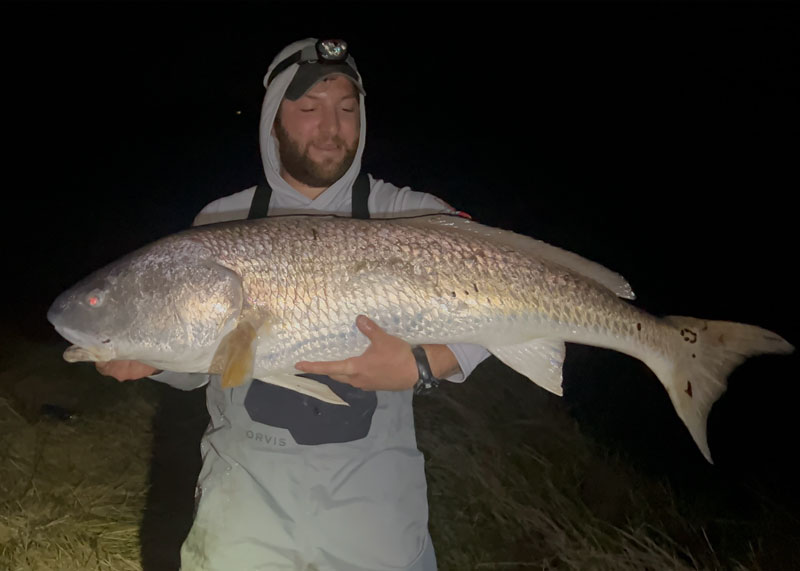
Bull Redfish at Night
Is it possible to catch bull redfish from shore in the daylight? Of course. However, the most consistent success I’ve had has come under the shadow of night. There are a couple of reasons for this. Redfish of “bull” class size can be anywhere from 20 to 60 years old. This means that these creatures have grown wise and wary of fishermen in their travels throughout the Bay and along the coast. Fishing pressure and boat traffic are typically much lower in the nighttime, so these fish feel more comfortable letting their guard down. That’s a win for you, the angler. The reds will come closer to the shoreline and be less apprehensive about chomping your bait. In addition to this, prey is more vulnerable and becomes an easier target in the dark. Baitfish will school up tightly and head for the shallows, and crabs will hug the bank. Bull reds will primarily rely on scent and their lateral line as opposed to sight to detect food when hunting at night, which is why fishing with bait is the easiest way to trigger a bite.
That being said, don’t throw stealthy tactics out the window just because a fish cruising the shallows may not be able to see you in the dark. Mr. Bull can still feel the vibrations of your voice or footsteps, and he’ll certainly smell the bug spray you had on your hands while baiting your hook. Minimize walking up and down the bank you’re fishing, converse with your buddies in a whisper, and rinse your hands before touching the bait. One more tip for nighttime stealth: only use your headlamp when you need to. That white light dancing across the water every time you turn your head could spook fish. Invest in some glow sticks that go on your rod tip so you can see the bites, and you’ll only need to turn on your lamp when absolutely necessary.
Rods and Reels for Bull Redfish from Shore
Just like anglers chasing bull reds from the beach, surf rods are ideal when using bait to catch them in the marsh. You want enough length for long casts to where the fish are feeding. It’s also essential to use a rod that can handle throwing up to six ounces, as you’ll want the bait glued to the bottom no matter the strength of the current. I like a rod in the eight to 10’ range, medium-heavy or heavy power. If you’re newer to surf rods start with an eight-footer. You’ll have an easier time getting accustomed to the casting mechanics of the longer stick.
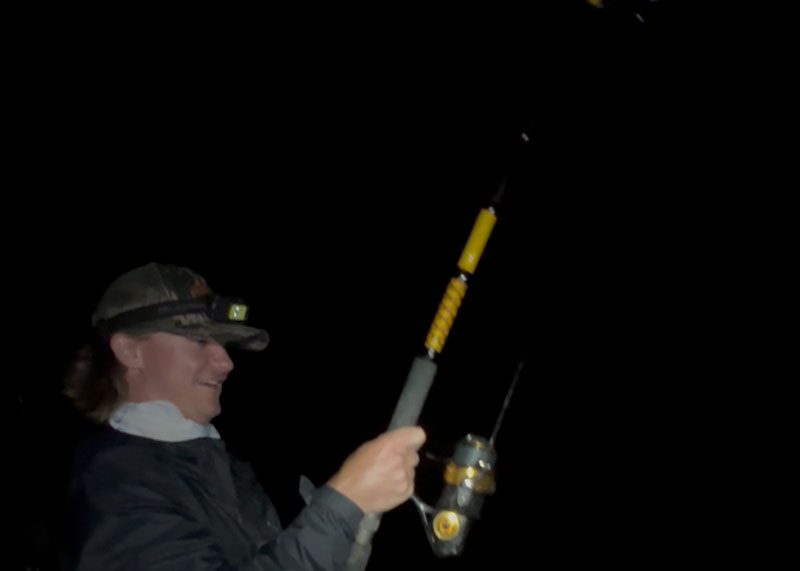
As far as reels go, any spinning reel in the 5000 to 8000 size range is great. Spool up with 30-pound braid, and use an FG knot to tie on a leader of 40- to 50-pound monofilament. Make the leader as long as your rod plus half its length again, to provide enough stretch to absorb the shock of casting heavy lead. It will also provide some abrasion resistance against hard structure or the rough scales of bull redfish. Add a sinker slide (a fishfinder rig) to the monofilament leader and tie off to a barrel swivel. Now, snell an 8/0 to 10/0 circle hook to a 10” or so length of 80-pound fluorocarbon leader, and attach it to the other end of the barrel swivel with the knot of your choice. It may seem like overkill, but the strong jaws and abrasive mouths of bull redfish can do some damage to the line.
The best bait you can use for these behemoths is live peeler crab. Many anglers rip off the top shell before hooking the crab, but I like to leave it on. This helps the bait stay intact longer, as many little critters will surely be pecking at your peeler while it soaks on the bottom and waits for a big fish to swim by. I’ll use shears to quickly dispatch the crab by cutting it in half, then remove the claws. Hook the peeler through the body cavity and out the backfin knuckle to keep it pinned. If live peelers aren’t an option, go with live or fresh spot. Cut the baitfish a few inches from the tail and then hook it through the mouth.
Bull Redfish on Artificials
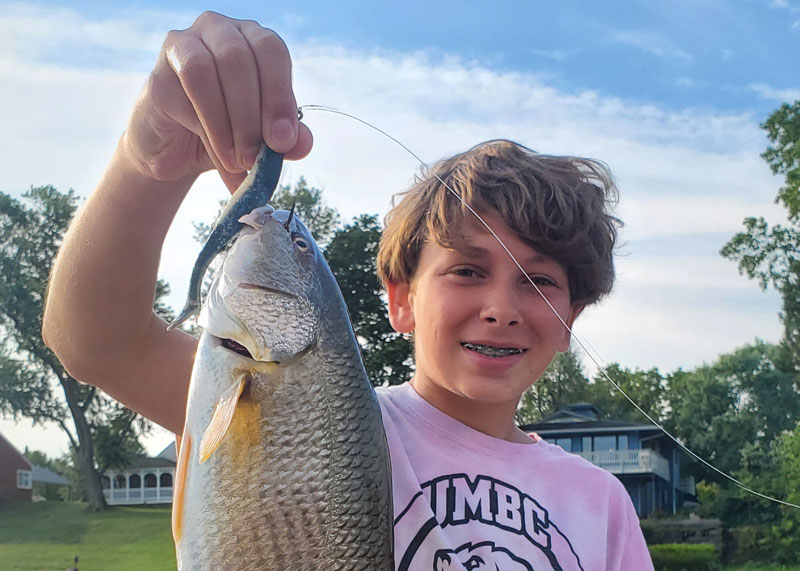
Chasing bull reds from shore with artificial lures is undoubtedly a more difficult game to play, but for those who want the challenge, pack a medium-heavy rod paired with a 5000-size reel. Spool up with 20- to 30-pound braid and tie a 40- to 50-pound fluorocarbon leader of about three feet. Remember, you’ll be catering to the olfactory and vibratory sense of these fish as opposed to the visual sense. In other words, use lures that are stinky and loud. Any Gulp! bait that resembles a crab or baitfish is a good option. Reds, as well as many other inshore species, go crazy for Gulp!. If you opt for a different brand of soft plastic, slather it in ProCure. Insert a rattle or tie your lure behind a popping cork for added commotion during retrieval.
Take a March Through the Marsh
There’s a ton of public access to fish for bull reds on the Eastern Shore of the Chesapeake. Obvious places like the Hooper’s Island Bridge in Maryland or the Kiptopeke State Park Fishing Pier in Virginia are great areas to start, however, I have found the best success while “marsh hopping.”
Marsh hopping is similar to the concept of pond hopping for largemouth bass or creek hopping for snakeheads. I’ll simply drive around the Eastern Shore, from south of Cambridge all the way to Cape Charles, and test out different spots until I strike gold. Just be sure to explore within the confines of the law.
When getting ready for a marsh hopping trip, I’ll open Google Maps and Navionics and look for a couple of factors to determine which spots to hit. Bull redfish tend to feed on large mud or grass flats where prey like crabs and baitfish will congregate, so I’ll search for marsh shorelines with those areas within casting range. It’s also very important to check ease of access before marching into the marsh during the dead of night. Is the spot you’ve scouted roadside, just a few feet from where you can park? Or will it require an extensive hike through the muck? The latter will require you to closely monitor tides while fishing so that the water doesn’t rise to the point where you can’t get back out to your vehicle.
The pursuit of catching bull redfish from shore in the Chesapeake Bay is one that is highly challenging yet immensely rewarding. With any luck, sharing what I’ve learned in my journey will give a mighty boost to yours. No boat needed. Just two feet, a fishing rod, and a dream. Now get out there and catch some bulls from shore!
-By Adam Greenberg