Acres of Manokin River oyster bar surfaces, which were worn down decades ago by mechanical dredges, have been revitalized with a thick veneer of stone substrate. The surface is very ragged because of the size of stone that was used, and some of the deposits straddle drop-offs. Combined with the adjacent remnant oyster bar structure and considering how these features jut out into the river tidal flow, put this spot on your prospecting list! It’s an example of why recreational anglers should encourage and support oyster restoration generally, and artificial structure in particular. The return on investment is three-dimensional reef structure, improved water quality over and around live oyster reefs, cover for baitfish, foraging opportunities for finfish, and of course, more oysters.
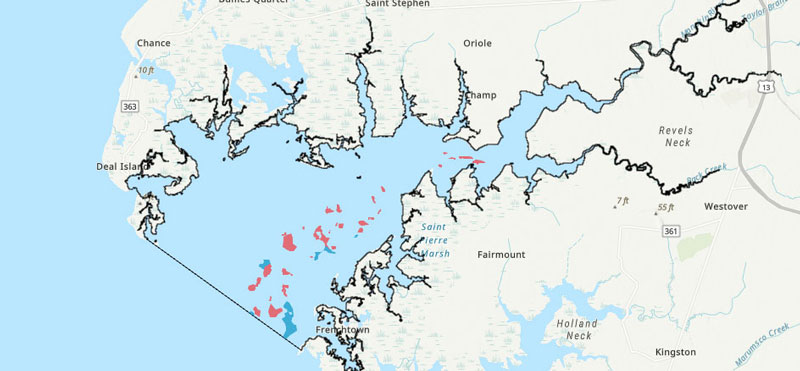
All this new reef structure is part of the Chesapeake Bay Program’s Ten Tributaries initiative. The goal per the Chesapeake Bay Watershed Agreement was to restore and then protect oyster habitat and populations in 10 Bay tributaries. Large-scale restoration and protection of oyster reefs and live oysters in the Manokin River is one of the flagship projects. But the Manokin story starts earlier and includes a restoration field test in an oyster sanctuary which contributed substantially to the use of reef balls as structural cultch for oyster restoration.
Resource protection is fundamental to successful oyster restoration programs. This is 100 percent necessary because of the past history of overharvesting and poaching. A number of oyster sanctuaries were designated by the state of Maryland including the Somerset Power Dredge Oyster Sanctuary at the mouth of the Manokin River. Further inside, the area east of a line between Pin Point on Little Deal Island and Hazard Point at the northwest end of Jerico Marsh on Hazard Island has been a state-designated oyster sanctuary since 2010.
The Manokin River bottom is physically well-suited as oyster habitat. This was demonstrated by what proved to be a pivotal field test two decades ago. Oyster shell for use as cultch in oyster propagation was becoming increasingly scarce during the early 2000s, so the Maryland DNR sponsored tests of various materials including prefabricated structures as oyster reef substrate to serve as alternative cultch. Reef balls and concrete pyramid fish havens were tested at various locations.
Reef balls in multiple sizes are poured from specially formulated concrete which has a neutral pH on its exposed surfaces. Tests conducted in 2003 included setting spat on reef balls at the Horn Point Oyster Hatchery and placing them in open water and in tributaries to see if they could catch a natural spat set. As part of the Maryland DNR-sponsored project, a truckload of 75 400-pound balls were purchased from Reef Innovations, Inc. in Florida, by the Maryland Environmental Service (MES). The initial plan was to deploy all 75 modules in a sanctuary off Point Lookout. Since the primary objective was to see if they could catch a natural spat set, the DNR adopted my suggestion to split the deployment between three geographically separate sanctuaries to triple the chances. One of the two added deployment sites, the Somerset Power Dredge Oyster Sanctuary, caught a spat set. During the decade that followed, biological development was spectacular.
The Chesapeake Bay Foundation (CBF) sponsored a field investigation of the Somerset reef balls during 2014. The inspection team found a thriving, fully functional oyster reef. Oysters ranged from freshly set spat on shell through juveniles to large mature oysters—the reef was repopulating itself!
The difference between this reef and a naturally occurring reef was that the reef balls served as the core rather than natural oyster rock. The discovery of a fully functional living oyster reef contributed to CBF’s incorporation of reef balls into the organization’s oyster restoration program. Subsequent field tests and deployments by MES, Maryland DNR, CBF, the Oyster Recovery Partnership (ORP), the Coastal Conservation Association (CCA), and others contributed significantly to the use of reef balls in restoration work, living shoreline deployments, and artificial reef development in Maryland’s Chesapeake Bay and Potomac River waters.
Fast forward to the Manokin River oyster restoration work this go-round, which began in 2021. The project included seeding existing reefs with oyster spat on shell and by depositing stone substrate on suitable bottom to serve as cultch, followed by seeding with oyster spat. A total of 441 acres of reef restoration was planned and the initial restoration work was completed by 2025.
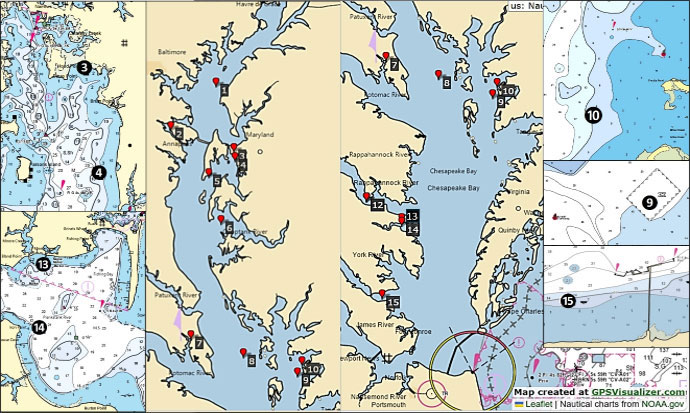
Recent monitoring found that 75 acres of previously constructed reefs met oyster density goals from natural recruitment. As a result of massive investment in restoration, including this project and similar reef restoration in other Maryland and Virginia tributaries, there’s a lot of new oyster reef structure for recreational anglers to prospect. Chart 1 provides a sampling of constructed oyster reef locations you can check out and there are a whole lot more, some charted and some not. Looking forward, plans are to write up more of these reefs. But those highlighted here give you a steer towards some great fishing structure.
-By Wayne Young
As well as being a regular contributor to FishTalk, Wayne Young is the author of multiple books detailing wrecks and fishing reefs in the Chesapeake Bay, Delaware Bay, and beyond. All are available at Amazon.com, and you can find his Facebook page at “Chesapeake Bay Fishing Reefs.”