You see rockfish rolling on the surface, cast time and time again, and you can’t get a bite… What the heck is going on?!? Then, you notice a steady stream of little red worms wiggling as the current carries them past. It’s those cursed May worms—ARGH!
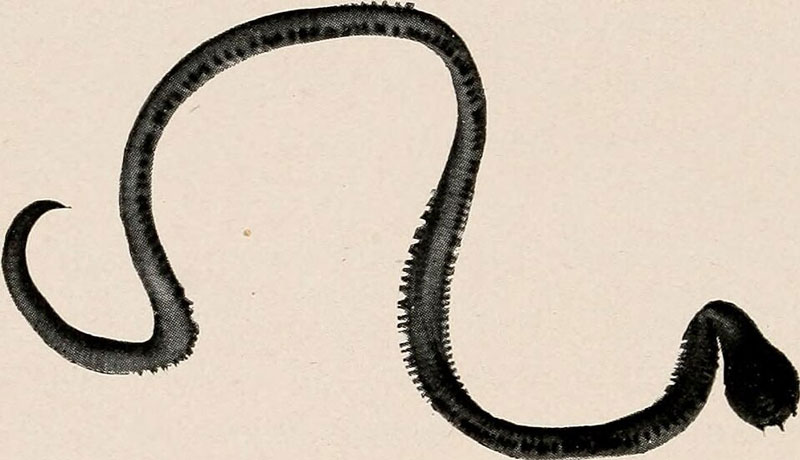
Perturbing Polychaete
Countless Bay anglers have lived out this scenario while fishing in May, when the May worm “hatch” goes off. Except that it’s not a hatch at all.
These are the same type of little worms that you’ll find crawling along oyster shells and wiggling in the Bay’s muddy bottoms; polychaetes (segmented marine worms, sometimes known as bristle worms or cinder worms), cousins of the larger bloodworms we use to catch a wide variety of species. In May, peaking at night around the full moon, the clam worm Nereis Succinea wriggles out of the tubular burrows they construct in the bottom with sand and mucus, and swim to the surface where they swarm, mate, and then die. It isn’t a hatch, it’s a spawn. And for a rockfish or a white perch this isn’t a mere ringing of the dinner bell—it’s an unlimited feast.
For eons we Chesapeake Bay anglers have groused and groaned over the May worm hatch. The fish are so focused on vacuuming up the tasty morsels that our jigs, spoons, and plugs often go virtually unnoticed. And when you do manage to land a rockfish while the May worms are going off it’s often bursting at the seams, belly packed full with those strange little critters.
Matching the Hatch
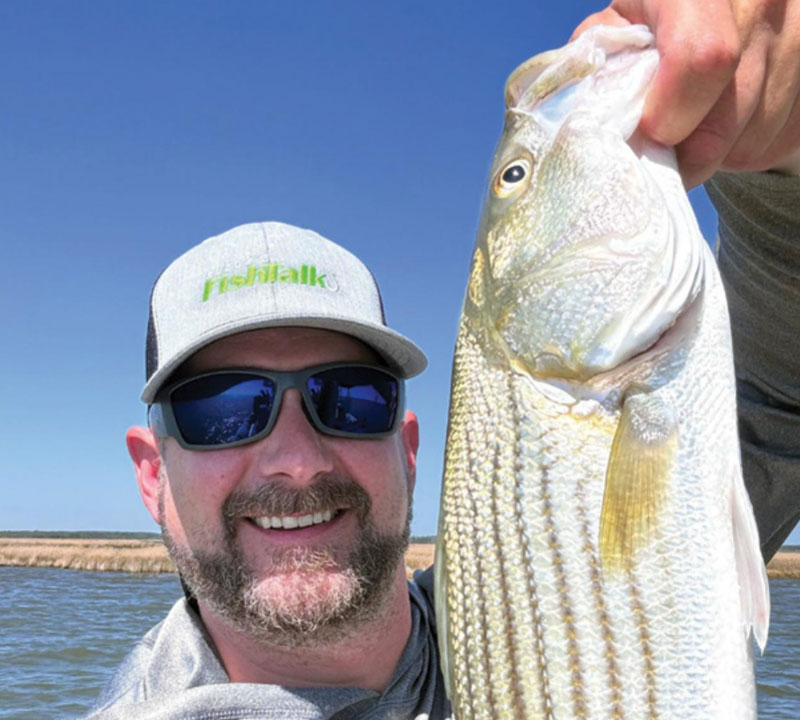
For many years I myself battled the May worm conundrum with limited success. I practiced (and preached) the plug-and-dropper method; tried larger red plastics on jigheads; and timed trips for late in the day to avoid fishing early in the morning after the fish had gorged themselves all night long. And then I watched as the Zach Rig was on-the-spot invented—and utterly crushed it.
I spoke of the Zach Rig in a Notes From the Cockpit column shortly afterwards, but of course by then the May worms were gone and it was too late to be of much help to anyone. So, here’s a recap: The water was full of wriggling May worms and four experienced anglers on the boat (myself, Contributor Eric Packard, Reports Editor Dillon Waters, and Art Director/Production Manager Zach Ditmars) stood dejected as rockfish were rolling to the left of us and to the right of us, yet we flailed the water to no avail. Zach dove into his tacklebox and went dark for a couple of minutes, then resurfaced, took a cast, and immediately hooked up with a 25” fish. On the very next cast he hooked another. And then another… and we all began scrambling to make up a “Zach Rig.”
Step one in constructing the rig is tying on a popping cork. Then, tie on two feet of 20-pound fluorocarbon leader terminating in a 1/0 to 2/0 swimbait hook, the EWG variety with an offset in the shank just below the eye. Next cut a two- to three-inch segment of FishBites artificial bloodworm strip. Slide it over the hook point, and slide that end all the way up to and over the offset bend. Then push the far end of the Fishbites strip onto and back through the hook point. Now with the Fishbite strip strung between the bend of the hook and the offset you’re ready to cast out, give the cork a few chugs, and wait for it to get yanked under. If and when it does, set the hook immediately.
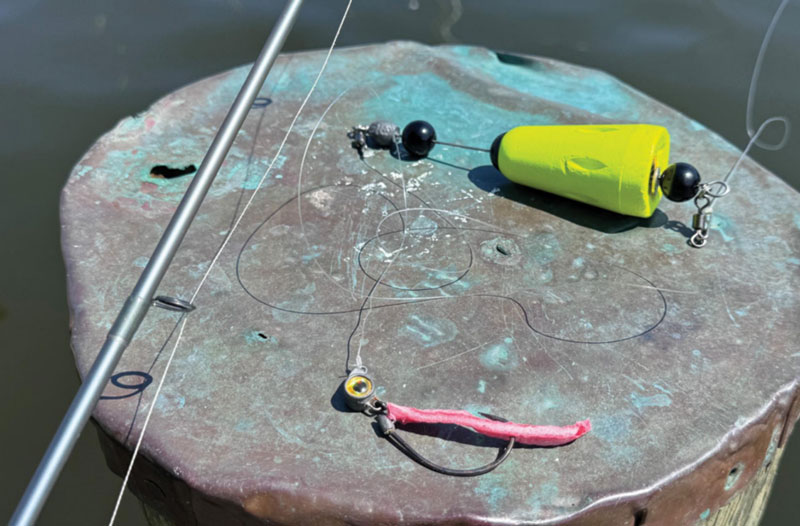
Since the initial discovery the Zach rig has also been successfully used with a swiveling “Texas Eye” style jighead (which has the same offset in the shank), and it’s been assembled using several different types of popping corks. The specific sizes, colors, and rattles don’t seem to be critical details.
Trading Places
The worms are often thickest where the current drains marshy areas then hits a point or creek bend where the flows (and thus the worms) get concentrated. Marsh guts with sod banks dropping off to five or more feet and good current also makes for a prime pick. Note that north of the Potomac River, due to the lack of Western Shore marshland this is mostly an Eastern Shore phenomenon.
Just a few years ago I’d often avoid areas where I knew the May worms were thick, because I knew there would likely be fish there that I couldn’t tempt into biting. Now I’ll be reversing that decision and seeking such spots out. And instead of cursing those worms in my head, I’ll be thanking Zach.