You and your fishing buddies have made plans to kayak fish tomorrow, you’ve talked it out and plan to be on the water by seven. You picked out the baits, rods, and laid out your clothes for an early start. Now it’s five in the morning, you’re up early and made a cup of coffee, and before you head out the door you check the weather again. Fudge! What the heck!! WIND… the stupid wind. UGH!! They weren’t calling for that big breeze last night… We’ve all been there. So, what to do now? I’ve learned over the years to have a Plan B. Same goes for when the issue is equipment failure as opposed to weather. I don’t get discouraged and I will surely get out to fish. Over the years I’ve learned to rely on well laid plans. Weather and broken equipment happen, but can be overcome.
Let’s start with weather. Planning ahead is paramount. With the issue of wind, you can escape it by hiding on leeward sides of points, shorelines that are protected by trees, and smaller bodies of water. Simply planning ahead with a second (safe) location to fish in mind will keep you on the kayak.
If it’s raining, well, all good—the fish don’t care. But if there’s lightning it’s a no-go. That’s one form of weather that can shut you down for sure. Cold weather can be challenging, too, but if you get the proper winter gear it won’t be a problem.
What about equipment issues? Let’s say you’re out on the water and the battery that you forgot to charge dies. Now you’re blind to what’s below you, but don’t get discouraged. Unless you’ve never fished that lake or spot all is not lost. Rely on your memory of the area and line of sight—like in the days before electronics—to pick apart a fishery. Yep, when I’m out fishing, I rely on this simple and proven method of locating underwater structure where I’ve caught in the past by lining up landmarks. In order to do so you’ll need to use line of sight even when your electronics are working. When you locate a hotspot scan the shoreline and look for spots that line up (like a house on the shoreline, an unusual and recognizable tree, or a distinct boulder) to where you’re fishing, and cross that with a second spot in a different direction. Do this a few times on different occasions, and after that you’ll be able to find the spot even when your electronics are dead.
Of course, other stuff breaks, too. Kayak parts can fail, and while it isn’t practical to carry back-ups for everything it’s good to always carry a multitool. Then you can at least make emergency repairs to items like steering and rudder cables, tighten loose screws, or return bent items back to shape.
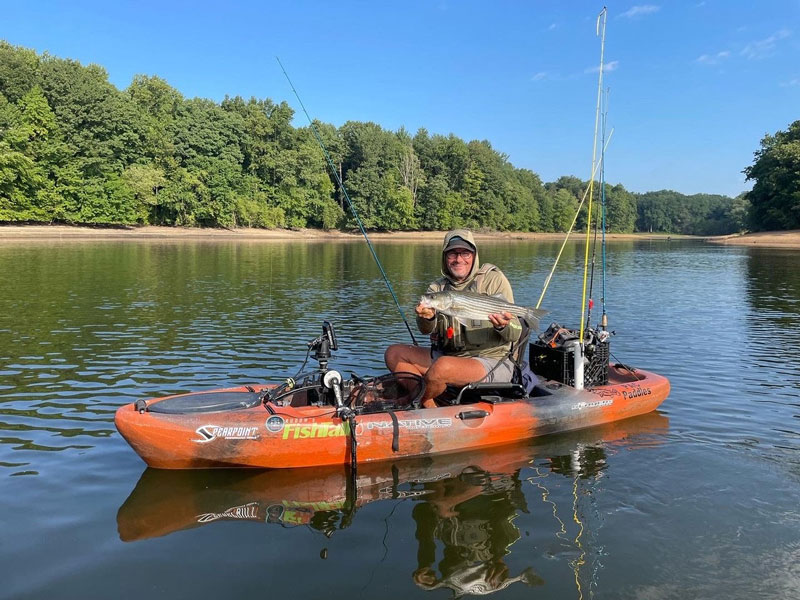
I always take more than one fishing rod in the event I break one or my reel fails. (Editor’s note: more than one?! We’ve never seen Eric show up with less than three.) But we kayakers know that space is limited on the boat. So, taking all your tackle with you isn’t an option, but having backups is important. When I select baits for the day for the species I’m targeting I’ll take a few baits that I can use for other species in case the bite is off for my targeted one. There will always be panfish willing to eat a micro jig or a Fishbites bloodworm. Take a few alternate baits just in case.
If a friend cancels, well no problem there. Kayak fishing is basically solo fishing. So no matter—get out, take the cast and send plenty of fish pics to that guy who couldn’t make it out on the water.
-By Eric Packard