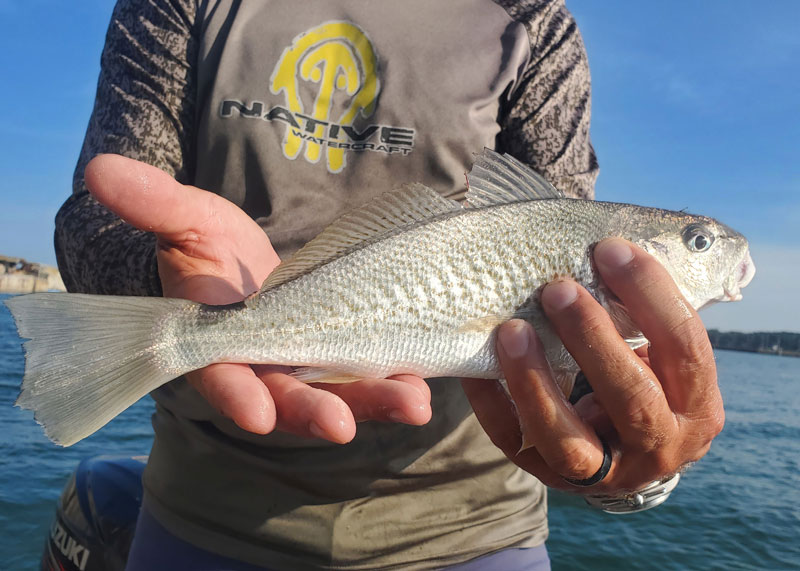
In the grand scheme of things it wasn’t all that long ago that croaker (AKA hardhead) were a summertime mainstay for Chesapeake Bay fishing. Sure, it’s been over a decade since we saw the runs of big “horse” croaker, but for several years now we’ve seen more and more small croaker mixed in with the catch while fishing for spot, and in the last couple of years it’s been possible to put together a dinner’s worth of keepers in southern areas of the Bay. Could this species be on a rebound? We can’t say for sure. But in late April of this year reports of croaker catches, including some keepers, were already trickling in from Ocean View, the mouth of the James, and nearby locations. And considering the recent trends it seems that it might be possible to catch a few, at least, if you’re willing to focus in on them. If, that is, you can remember how and where those tasty, noisy fish can be caught.
Hardhead Hotspots
Like most other fish, croaker will and do change where they frequent from year to year whether they’re thick or few in number. That said, also like other fish, there are common factors to look for as you lay out a gameplan with different spots to try. You’ve heard of Maslow’s Hierarchy of Basic Needs, right? Five critical things are needed for a human’s physical survival: food, drink, shelter, sleep, and oxygen. This explains why you don’t often find people living in the middle of the desert, where there’s a distinct lack of food, water, and shelter. Many parts of the open Bay are like a great desert, too, with pockets of life that are more or less like an oasis in the desert.
Intelligent anglers will think of fish and where they hang out in exactly the same way as Maslow’s Hierarchy relates to people. We can eliminate drink from the list—fish do, after all live in water—and perhaps substitute “rest” for “sleep,” but otherwise the Hierarchy holds true. Find an area with structure that provides food, shelter, rest, and sufficient oxygen levels, and you will likely find fish. Go to an area that has none of the above, and generally speaking your bait won’t get bit.
Croaker are bottom feeders with a downturned mouth, and they feast mostly on small crustaceans, worms, and mollusks. While looking for spots that fulfill the “food” part of the Hierarchy they’ll gravitate towards live bottom, reef sites with biofouling, and oyster bars. Though they do go shallow sometimes croaker tend to like slightly deeper water than some species, and usually 10’ to 25’ is a good bet. When they’re in the southernmost portions of the Bay expect to find them in places as varied as Kiptopeke, Cherrystone Reef, and Nandua-Pungoteague. When they shuffle north areas like the oystery edges of the Tangier Sound channels, the live bottom south of the Target Ship, and Butler’s Rock can become thick with them. They may keep going up the Bay to the Gooses reef, the Choptank’s Cook Point Reef, Cedarhurst, and some years they’ve been thick as far up as Snake Reef above the Magothy.
But—and this is a big but—remember that one of the croaker’s favorite foods are worms. To find them, croaker will sometimes move en masse into deep cuts with undercut banks and sharp drops. The cuts through Deale Island and Wroten Island, for example, have swarmed with them in the past. And after dark they’ll sometimes move shallow over muddy bottom, which has led to epic evening bites in past years off Herring Bay and Franklin Manor.
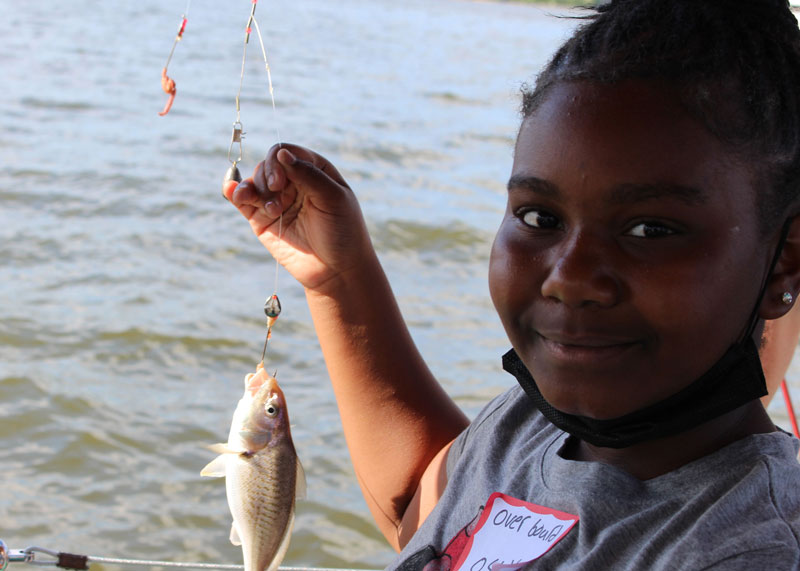
Also remember that even if the croaker are undersized, croaker are a top target when fishing with kids. They do plenty of croaking and grunting when you reel them in and there isn’t a kid around who won’t start laughing and smiling when they hear the fish “talking” to them. If you’re trying to entertain youthful anglers for an afternoon, croaker fishing is ideal.
Simple Croaker Fishing Tactics
One of the great things about croaker fishing is that this species will reliably bite on the simplest of rigs and baits: you just can’t beat bloodworms on bottom rigs. Shrimp, Fishbites, peeler crab, and any number of other baits will work, too, but if the fish are present and willing to eat bloodworms never fail. A half-inch tidbit threaded onto a number four or number two hook is all it takes, though if larger croaker are around you may want to upsize a bit. Add enough lead to the rig to keep it on bottom when you cast out from a pier or shoreline, as you drift, or when you anchor up.
Rods of six or seven feet with moderate action are best since some give in the tip helps keep tension of the line without pulling the weight off bottom, and longer rods can be advantageous for shoreline anglers trying to make long casts to deeper water. Reels can be anywhere from the 3000 to 400 size with 10- to 15-pound test line.
Night Fishing for Croaker
Croaker often get very active after dark. It’s generally not “necessary” to wait for the sun to go down to catch them, but often the hottest action is after the sun’s gone down. If you’d like to try night fishing on the Bay or its tributaries, this is an excellent species to target.
We don’t know when or if croaker will make a major-league comeback anytime soon. But their numbers have been strong enough in recent years that if you target them and spend some time and effort you’ll likely be rewarded by that jackhammer-like strike a time or two—and hopefully you’ll even be able to put together a mess of croaker for the frying pan.