Frogs were always a largemouth bass lure, until they weren’t. Well, they do still catch plenty of bass. But these days in the FishTalk zone of coverage more people fish them because they’re an excellent snakehead bait. In fact, if you Google “what’s the most popular snakehead lure” the AI overview comes back with: “The most popular and versatile lure for snakehead is the hollow-body frog.” Well, as usual AI gets it half-right. Frogs are indeed mega-popular, but they most certainly are not versatile. They’re best applied in very specific circumstances—and if you try using them in the wrong place at the wrong time, you’ll catch bupkis.
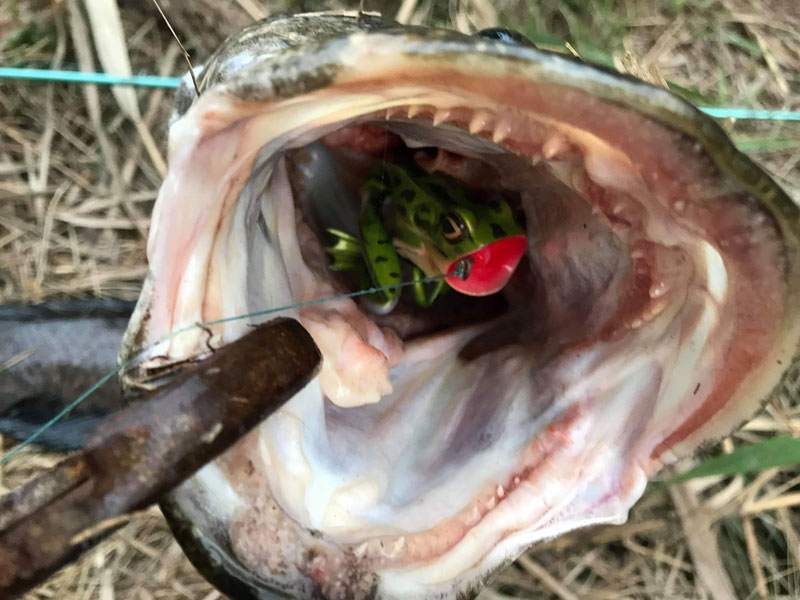
What Are Frog Lures?
Frogs are hollow, flexible, rubbery plastic lures, often shaped like the real thing but sometimes in rather zany shapes and colors. Many have rubber skirt legs rather than molded legs, and a few have twisters, paddletails, or even spinner blades on the end. Some have concave faces that pop, while others are rounded or pointed. Almost all have a hook or hooks that come out the back and lie right up against the lure itself. This makes them very weedless (though not 100 percent), so they can be pulled through lily pads, reeds, and other vegetation. Their flexible nature makes it easy to compress the hollow body, so when a fish grabs the lure it collapses, exposing the hook-point.
Just like the real thing, frogs are buoyant by nature. Since their bodies aren’t exactly watertight, however, some fill up with use and become less and less buoyant through the course of the day. When this happens you’ll want to give ‘em a squeeze or a shake every now and again so they float properly on the next cast.
When to Use Frog Lures
Since frogs are topwater lures, they work best during the warmer months of the year when fish are feeding on the surface. Generally speaking, that means water temperatures are well over 60 degrees and fish are in just a couple feet of water or less.
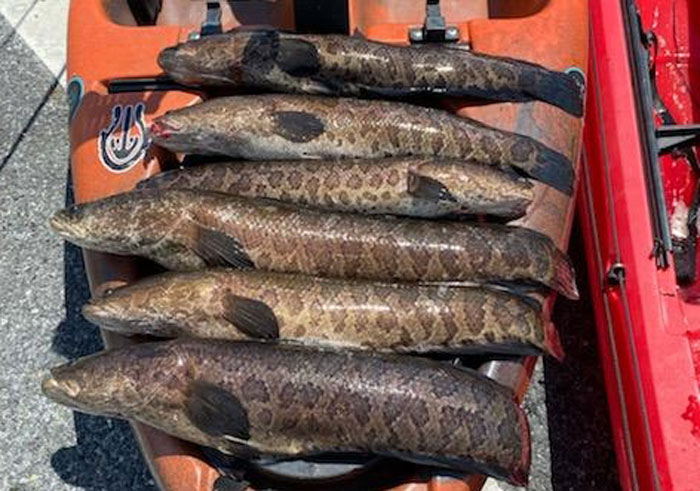
The best time to reach for a frog is when fish are hitting topwater but are socked in deep cover where anything else would become hopelessly snagged. You can drop a frog into a tangle of deadfall and haul out a bucket-mouth bass. You can pull one through a field of lily pads so thick that the lure spends more time dragging across greenery than it does going through the water—until a snakehead explodes on it from below. And you can cast one onto dry land then inch it out between the reeds and cattails right off the shoreline until a vicious attack ensues.
How to Fish a Topwater Frog
The first key to fishing a frog is casting accurately into the thick of the cover. If it plops down on something solid, like a lily pad, tree trunk, or the shoreline, immediately pull it just far enough to enter the water and let it sit for a second or two. Don’t worry, any nearby fish sensed the vibrations when it touched down and is likely looking in the right direction. Similarly, if it landed in open water let it sit for a few seconds before beginning a retrieve.
Assuming it doesn’t get blasted instantaneously, start reeling. Will they like it fast? Will they like it slow? Will they like it steady or erratic? These are all questions the fish will answer, not you, so vary your retrieve style until you start getting hits and then stick with what works on any given day. That said, remember that you’re trying to mimic the real thing. It’s usually best to go fast between lily pads and slow down when the lure reaches their edges, just as a real frog would. And if you see a fish waking towards the bait don’t stop reeling—that will look about as unnatural as it gets, because the real Kermit would be paddling for his life.
Now for a dirty little secret: it’s rare that I personally fish a frog. I’m just too dang excitable when a fish blows up on my lure, and most of the time I instantly rear back to set the hook. Half the time I send that frog flying and sometimes I have to duck my own lure as it goes zinging away from the fish. And herein lies the most critical part of becoming an effective frog angler: you need to wait for the fish to completely engulf the lure in its mouth and chomp down, so the hooks are exposed when you yank the rod back to set the hook. On the explosion, drop your rod tip towards the fish, pause for a second or two, and then set the hook.
That second or two feels like three years when the water is flying. I’m downright incompetent at forcing myself to wait, and I’ve had days where a friend and I fished frogs shoulder-to-shoulder, we both had a dozen snakehead strikes, and he put 10 fish in the cooler while I only managed two. If you can learn some self-control and master fishing with a frog, however, you could be that angler who’s struggling to lift a heavy cooler at the end of the day.
-By Lenny Rudow