Fall angling for striped bass can be red hot, but it can be frustrating, too. One particularly vexing situation is when you know there are fish around but can’t seem to get one on the line. Maybe the rockfish are exploding in brief frenzies on the surface then disappearing in a matter of moments, maybe they’re widely scattered over a large area, or maybe they’re only biting during a brief window. In all of these cases light tackle trolling can save the day—especially if you’re on a small boat or a skiff and don’t have the option of running to far-off hotspots or competing with a fleet chasing bird-play.
The Gear for Light Tackle Trolling
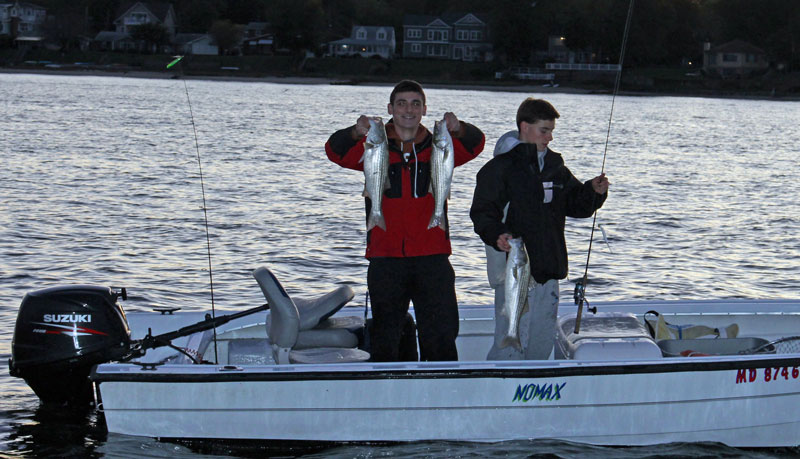
The beauty of working the LTT is that you don’t need a bunch of trolling gear, but instead employ the very same lighter rods and reels you’d commonly cast with. Many years ago when the tactic was popularized by Francis Zell, a Maryland angler, he told me it was simply born out of necessity: as a poor college student at the time he didn’t have the cash to run out and buy a bunch of trolling gear, so he gave it a shot trying what he had—and discovered it worked, even when hunting big trophy fish. A set of common 6’6” spinning or casting rods with 3500 series reels and 15-pound braid will work just fine for chasing fall slots, and if you don’t have that, well, use whatever you’ve got.
Lures can vary but the same ones you cast will likely serve you well. Four- to six-inch paddletails, jerkbaits, and diving lipless plugs will generate hits. That said, when using jigs for the LTT you may want to upsize the leadhead of your offering or it may ride right along right at the surface. And it’s best to stay away from plastics that have straight tails unless you jig them as you troll, since most of these don’t have a ton of action all on their own.
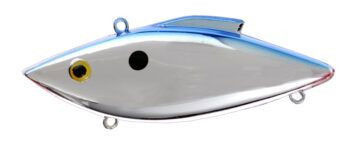
All of that said, in my personal experience the three-quarter-ounce Rat-L-Trap in chrome/blue is an utter killer for light tackle trolling and in a mixed spread often catches the lion’s share of the fish. But note that sinking models can swim pretty deep and aren’t ideal in water under six or eight feet, so if you’ll be working the shallows be sure to get a floating model.
That’s really all you need. Well, a net too, of course, but you can forget about inline weights, planers, specific trolling lures, and—God forbid!——thank goodness!—planer boards and clips.
Employing the LTT
Again, this is pretty simple, folks: putt-putt or pedal-pedal along at a very slow speed as you tow those lures. Walking speed is fast for the LTT, and a mere two mph of headway is usually all you’ll need to keep the lures swimming.
Whether you’re on a small skiff or on a kayak it’s usually best to keep the spread limited to avoid tangles. Two lines work just fine, three is a lot, and four may be do-able for some but too much for some others. On my skiff I stick with three lines, first casting a paddletail straight out the back as far as I can then letting out more line with two or three sweeps of the rod with an open bail. That rod gets set in a center holder, then a Rat-L-Trap will get heaved off of either side without letting any additional line out after it splashes down. That way the side lines are shorter and deeper, and if the boat is turned too tight and the lines cross, hopefully the paddletail line will swing across and back without tangling.
As with most types of trolling, as a rule of thumb it’s best to run a contour or drop-off and zigzag along it so you cover some different depths until figuring out where the fish are. If there’s sporadic bird play, yes, head for the birds and troll areas where they recently showed themselves. But don’t feel like you have to increase speed or yank your lines and get there asap. These days much of the time the birds will have broken up by the time you get there, regardless, especially if there are other boats zipping around in the area.
An example: five or six years back when fish were clustered in small pods in the mouth of the South River, birds would gather in small groups for two to three minutes at a time during the last hour or so of daylight. One evening after work I jumped into my skiff and tried chasing them and casting to no avail, while a neighbor was out there in his kayak trolling up and down along the drop-offs. After a while I decided to try trolling, deployed my lines, then saw a flock forming on the other side of the river. I cranked everything back up, zipped over, re-deployed lines, and no more than a minute later the birds broke up and began re-forming where I had just been. I did manage to scrape out a couple of fish that evening, but when I got back to the pier and spoke with that neighbor, he had caught six. Ouch.
I was a little frustrated that evening, and if you’re an angler there’s no doubt you’ve felt the same way at one time or another. The bad news is that you can bet it’ll happen again. The good news is that if you learn to employ the LTT, it’ll happen less this fall than it might have otherwise.