In 2024 I was invited to jump on a boat to catch striped bass — out of season! After learning it was to participate in a George Mason University Fisheries Ecology Lab study on the catch-and-release of striped bass, I was all in. The study was to determine catch-and-release mortality of striped bass in their natural environment. A fixed 9.0 percent catch-and-release mortality rate (CRM) is generally used by fisheries managers. This rate came out of a study conducted in 1996 in a saltwater pond in Massachusetts and a few other outdated studies, which don’t account for critical variables like water temperature.
The area of study was the Patuxent River between the Maryland Route 231 bridge and the mouth of the river where it meets Chesapeake Bay. By using acoustic telemetry tags and telemetry array receiver stations placed throughout the area to track the fish, scientists can determine if the fish survived. (This tagging system is most commonly compared with the way your EZPass works; the telemetry tags “ping” the receiver stations as the fish swim by).
Two of the study’s primary objectives were to estimate CRM of Chesapeake Bay striped bass, and to determine the relationship of striped bass CRM with respect to water temperature. The first step was to catch striped bass for the study in spring, summer, and fall. That wasn’t as easy as one would think, because summer can prove to be a very difficult time to catch on the Patuxent River.
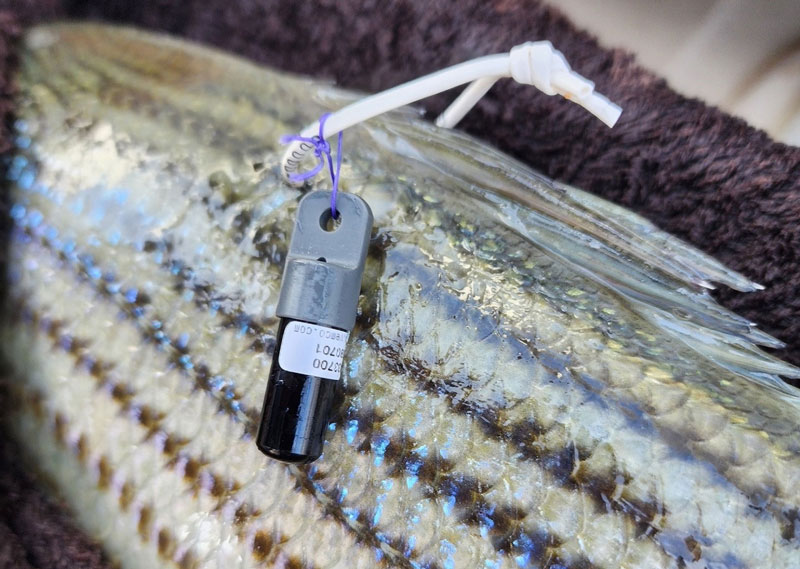
We used light tackle gear rigged with jigs and plastics. The fish that were caught were measured and scales collected, then tagged with vinyl Floy tags with printed information to report a catch to TAG Chesapeake and with Innovasea V9 acoustic tags with a dissolvable suture. The acoustic tag would be monitored for a minimum of two months, at which time it would drop off of the fish.
We caught 50 fish in the spring, 28 fish in the summer, and 22 fish in the fall, for a total of 100 striped bass in the study. Across all seasons on average there was a CRM rate of one percent within the first two weeks and 7.7 percent at eight weeks. In the spring the CRM was 4.9 percent, summer was 11.3 percent, and fall was 7.0 percent. One of the main objectives of the study was to determine the CRM rate with respect to water temperature. It was found that as water temperatures reached 77 degrees Fahrenheit and above CRM increased. Mortality increased significantly at week four, which was when the study observed the highest mortality rate. Mortality could be caused by any number of factors, but similar patterns between spring and summer indicate that catch and release was the probable cause. Gear type could also influence mortality, so further studies with different gear types need to be done to validate this finding.
As a catch and release angler I found the study very enlightening. I learned first and foremost that CRM can occur up to eight weeks after catch and release. Second, that more accurate CRM numbers could be used to manage the species. Further studies are needed with a larger pool of fish, over all seasons, to refine these findings.
I am a catch and release angler, and I catch 250 to 300 rockfish a year. So, with the finding that CRM is at or around 7.7 percent I could say that I unintentionally kill around 20 rockfish per year. But what I have learned from the study is that I can reduce that number by limiting my time on the water during the hottest days of the year and adjusting when I head out to go fishing. As yet another way to limit harming striped bass I’ll target invasive species to mitigate my striped bass CRM.
-By Eric Packard